
As we live through the season of Advent and approach Christmas, it is fascinating to see how archaeology allows us to discover connections between material culture and this celebration. It is not about finding archaeological evidence of the birth of Jesus, but about appreciating something simpler, yet deeply meaningful: elements that connect us to the origins of Christianity and to the way tradition began to take shape.
The Gospel of Matthew describes: “All this took place to fulfill what the Lord had spoken through the prophet: ‘The virgin shall conceive and bear a son, and they shall name him Emmanuel,’ which means, ‘God with us.’” (Mt 1:22–23). This passage echoes the prophecy from the book of Isaiah: “Therefore the Lord himself will give you a sign. Look, the young woman is with child and shall bear a son, and shall name him Emmanuel.” (Is 7:14). In this way, the first followers of Jesus recognized in the Gospel of Matthew the fulfillment of the messianic promise announced by the prophet.
During the first centuries of Christianity, this verse was repeated endlessly: it was commemorated not only during Advent, but also in hymns, in liturgy, and even as protective amulets. One example is an ostracon—a fragment of pottery—dated to the late 6th century and discovered at the Monastery of Epiphanius in Egypt. This piece preserves an inscription containing one of the oldest hymns dedicated to Mary:
"Mary the Mother of God, the ever virgin, has borne for us today Emmanuel, both God and Man. “Lo the virgin shall conceive and bear us a son, and they shall call His name Emmanuel, which is, being interpreted, God with us.” Him did an archangel suddenly announce; Him did a virgin’s womb conceive without intercourse. A virgin conceived, a virgin was with child, a virgin was in travail, a virgin brought forth, and remained a virgin; before bearing, virgin, and in bearing, virgin, and after bearing, virgin"
In addition to this object, which is preserved at the Metropolitan Museum of Art in New York, there are also papyri, codices, and various texts that repeatedly cite the Gospel of Matthew, the prophecy of Isaiah, and the commemoration of the birth of Jesus as Messiah.
Why is this text important in archaeology?
Tradition. Archaeology allows us to see how tradition is built through belief and devotion; it becomes visible in the memory of texts and in the proclamation of the fulfilled promise. Therefore, as we celebrate Christmas, it is worth taking a moment to reflect on the beauty of this tradition: the fact that, by remembering and speaking these words, we join the voices from the past who also proclaimed them.
To learn more about the ostracon from the Monastery of Epiphanius, visit the Metropolitan Museum of Art website: https://www.metmuseum.org/art/collection/search/170014200
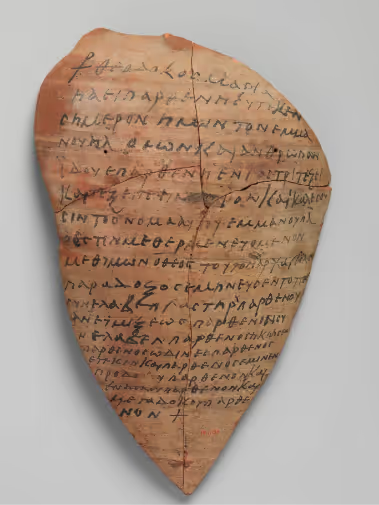
"Ostrakon with a Troparion (Early Hymn), ca. 580–640, cerámica con tinta, objeto no. 14.1.198, The Metropolitan Museum of Art, New York."
Discover more articles from this category