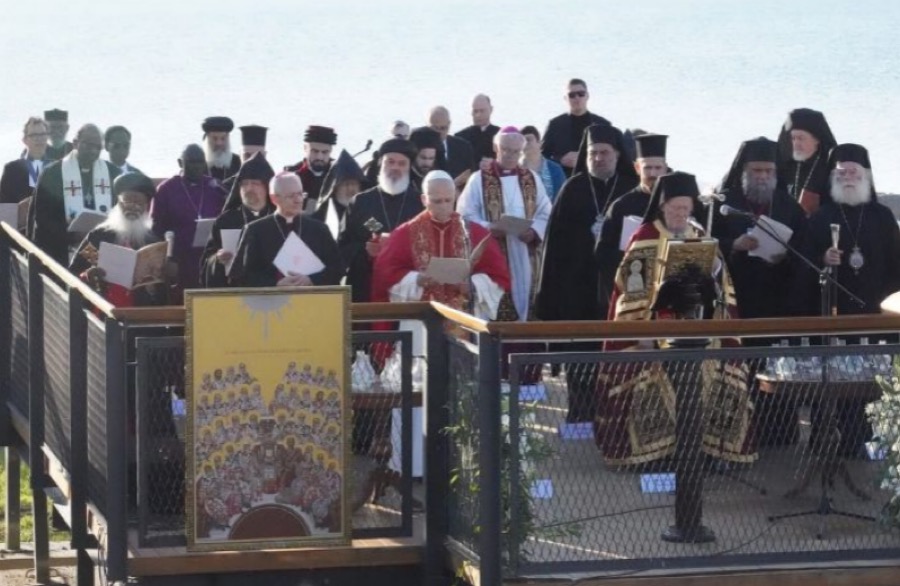
Encouraging soundbites and events have caught my attention these recent days. In January, some enterprising artists convoked the leaders of the Christian Churches in Jerusalem to an evening of prayer and fraternity! What a delight to spend those hours so close to our fellow co-workers across the Christian spectrum, and so set the tone for the Week of Prayer for Christian Unity.
Baptist, Wesleyan, Evangelical, and non-denominational pastors have come to Magdala for intense days of meetings to advance One Step Closer – Hospitality Together and were joined by Pentecostal and Lutheran pastors from The Netherlands and Germany. The time, travel and expense undertaken speak volumes about their desire to make Jesus’ Last Supper prayer heard: "May they all be one as you Father are in me and I in you” (Jn17:21). Anglican priests were also here for their own program. Both groups shared some moments together. Besides, many other groups of pastors have already come this year to Magdala.
A personal expression of Patriarch Athenagoras of Constantinople (from 1948–1972), “I am disarmed of the need to be right, to justify myself by judging others,” by waging “the hardest war, the war against myself” has deeply stirred my heart. Pope Leo quoted this while addressing monks and priests from a number of Eastern Orthodox churches last Thursday, February 5, 2026. Here is a more complete text attributed to Patriarch Athenagoras which is the English rendition of a French version. Hopefully some Greek Orthodox friends will help us with the Greek original source:
The hardest war is the war against oneself. One must disarm.
I waged this war for years, it was terrible.
But now I am disarmed.
I’m no longer afraid of anything, because love banishes fear.
I am disarmed of the need to be right, to justify myself by judging others.
I am no longer on guard, jealously clutching my wealth.
I accept and share.
I do not particularly care about my ideas, my projects.
If somebody suggests better ones — no, I should say good ones not better ones — I accept without regrets.
I have stopped making comparisons.
What is good, true, real, is always best for me.
That’s why I’m not afraid anymore.
When we have nothing left, we have no fear.
If one disarms oneself, if one dispossesses oneself, if one opens oneself to the Love that makes all things new, then that Love erases the bad past
and makes for us a new time where everything is possible.
Pope Leo goes on to highlight some concrete action points:
- Continue to support each other
- Learn to “disarm ourselves, our hearts”
- Wage “the hardest war, the war against myself”
- Remove the prejudices we carry within us
- Grow in charity and work more closely together
- Let Christian unity become a leaven for peace on earth
“Christ is our peace, who has made the two peoples one and has destroyed the barrier, the dividing wall of hostility” (Eph 2:14.)
Peace, however unattainable it may seem, is as simple as St. Paul makes it here. But there are many implications to this simplicity: our daily commitment to become artisans of peace in personal, family, community, and civic evidences that Christ is in us. “Anyone who says 'I love God' and hates his brother, is a liar” (1 John 4:20). But what Paul also meant is that there is no real peace without Christ. The true nature of peace is that of a gift of God, and that gift became flesh at a specific moment in history, but even more so, in a specific place.
IF THE HOLY LAND IS A SOURCE, then I also can be a source!
It seems absurd that the very place where true peace entered the world is now known as a place of hatred, division, and war. The fruits of evil are present in the Holy Land, there is no denying it, but that is not all there is. The Patriarch of Jerusalem, Cardinal Pierbattista Pizzaballa, reminded us that “The Holy Land is not merely a place to be supported, much less a problem to be solved; it is a source.” Its richness is not just in the “living memory of the Gospel,” but that in the brokenness there are still people choosing reconciliation. Cardinal Pizzaballa calls them “wounded healers.”
“There are people—believers from different communities, humanitarian workers, artisans of dialogue—who, though themselves wounded by the conflict, continue to weave relationships, to heal, and to listen. These people already embody a style of relationship inspired by the New Jerusalem: a style in which one is not defined by hatred, but rather by steadfast love and hope.” A gift for the whole Church. Where sin increased, grace increased all the more. In places where war and division are strongest, great examples of peace stand out.
I don’t need a war zone to showcase peace. I just need to face daily battles inside my own heart. Then we become a source of peace in our families and for the whole world.
THE SLOW PROCESS OF PEACE-BUILDING
The most natural temptation is to say: “My commitment alone, however great, cannot reap peace where everyone sows the weeds of discord.” But luckily, as Christians, we already knew that! Our efforts alone are in vain, but “I can do all things through Him who strengthens me.” He is our peace, not we ourselves, we have just to sow! If we start building peace from below, through family, forgiveness, patience and prayer, then it will come as a gift from above. There is no doubt that it’s a long and difficult journey, that’s why it’s so important to start educating a new generation of children to see the good, to build on the good and to spread the good. It’s not a path that can end with us. “Give your servant, therefore, an understanding heart to judge your people and to distinguish right from wrong. For who can govern this vast people of yours?” (1 Kings 3:4-13). This is what the young king Solomon asks God, not to fix his kingdom’s problems and spare him the effort, he asks for wisdom to accomplish his daily task.
A MILESTONE: THE CHARTA OECUMENICA
While some contemporary leaders do not seem interested in peace or wisdom, and exploit their people, how encouraging to see others who are already preparing the next generations of peacemakers. Negative news enjoys plenty of outlets for people's faults and failures, while their good deeds are overlooked and buried with them.
The Charta doesn’t simply aim to Christian unity through dialogue and prayer. Even if we are not one, we can work together as one: “In view of numerous conflicts, the churches are called upon to serve together the cause of reconciliation among peoples and cultures. We know that peace among the churches is also an important prerequisite for this. Our common endeavours are devoted to evaluating, and helping to resolve, political and social issues in the spirit of the Gospel” page 10.
In November, this renewed Charta Oecumenica was signed in Rome, an updated version focusing on practical engagement to address real needs around us. This is yet another hope-inspiring sign which encourages us all as we assist others around us, especially children and grandchildren to gain experience as peacemakers and reconcilers with their siblings and friends. Let’s mobilize the troops! Let’s invade the world with schools of peacemakers whose greatest ambition will be to foster reconciliation steps between even the worst of enemies.
Let’s lead by example: refusing to utter offensive words, choosing patience, and seeking the joy and peace of those closest to us—especially within our families. This is the real campaign, the daily and demanding struggle of the heart. If the Holy Land can still be a source of hope amid wounds, then so can I. Disarmed by Christ, I too can become a fountain where peace springs forth.
Discover more articles from this category