
Saint Paul said that “our citizenship is in heaven” (Phil 3:20) therefore we all walk this earth as foreigners, as pilgrims, as guests. That means that every relationship with others is a matter of hospitality (the word “hospitality” comes from Latin hospes, guest), we are always both guests and hosts. In the Bible, hospitality is not merely a moral duty; it’s a place of encounter with the other and therefore the place where the ineffable mystery of God’s love is revealed.
Usually this hospitality is shown in a specific place: around a table during a meal. This doesn’t strike us as strange. When we want to spend time with someone, we have dinner with them. People draw closer together physically and cordially. Distances are surmounted. Community is built. Meals transcend social ritual. Deeper treasures develop and emerge. We belong to each other.
In the Incarnation, following an angelic visit, God enters our human condition and, in Jesus, becomes our companion (a word also derived from Latin, literally meaning “the one with whom you share your bread”). In one of the most famous meals of all time, the Last Supper, Matthew 26:17-30, a major event of Salvation history happens through simple food. “Take and eat, this is my body.” The New Covenant is sealed, the inexpressible mystery of self-giving love is revealed through the breaking of bread and sharing the same cup of wine. Not even tragic betrayal weakens the powerful beauty of this overflowing cup of hospitality. “He who has dipped his hand into the dish with me is the one who will betray me.” Although treacherous hospitality dips the hand into the shared dish, a sign of trust, and hands over a companion to mortal enemies with another friendship gesture, a kiss, the original and ultimate source of all humanity’s hospitality responds with total self-giving. The host’s meekness still respects the dignity even of the person who has fallen into treachery, actively engaging like every parent for that rebel child to come home again. While hostility is the antithesis of hospitality, hospitality is the effective antidote to hostility.
Holy Thursday’s Last Supper hospitality masterpiece doesn’t happen in a vacuum. We have walked a long way with Abraham and his ever-growing family since he served a banquet to his mysterious heavenly guests (Gen 18:1-15). They eventually invite us to the marriage feast when they will serve us: “Blessed are those who are invited to the wedding supper of the Lamb!” (Rev 19:9; “he will gird himself… and serve them” Luke 12:37). Abraham immediately recognizes the three men standing nearby his tent in Genesis 18:1-2 as sent by God. Though it’s never explicitly revealed who they are, usually they’re called “the three angels”. Some percieve a hint of the Holy Trinity, an idea immortalized in Andrei Rublev’s Trinity icon. They don’t need to ask for hospitality, Abraham begs them to stop, rest and eat with him, to share his bread, which he asks his wife Sarah to make. His faith is rewarded: the three angels announce, “We will surely return to you about this time next year, and Sarah will then have a son.”
The encounter on Easter Sunday evening between the disciples of Emmaus and Jesus in Luke 24:13-35 takes us over the bridge to the new hospitality that Jesus offers us as the Unseen Guest. At first they don’t recognize him, not even when he explains to them the Scriptures and the meaning of his death on the cross. To them he’s a stranger yet they treat him with hospitality: “Stay with us, for it is nearly evening and the day is almost over.” During the meal, at the breaking of bread, they realize he’s not a stranger, he’s their companion, their Master and friend. They can’t understand the new revelation through mere words (neither can we); their eyes are opened to the reality of his new presence at the bread-breaking moment. Then he disappears from visible sight.
Ever since, on the first day of the week, the day of the New Creation, his disciples will gather to encounter him in the breaking of the bread. The Sunday-gathering transcends mere ritual: the one bread broken for us builds the one body of Christ which we are.
Jesus works his first miracle at the Cana wedding (John 2:1-11), another moment of conviviality and community. He first reveals his glory as a guest at a feast, this time using water. He inconspicuously turns something bland, tasteless and neutral into wine, something full of flavor, aroma and beauty. He does it as an allegory of the elevation of humanity from a fallen and empty nature to a new and beautiful life. The wine also will overflow from the New Covenant cup which he offers for our redemption, a share in the greatest love.
A woman anoints Jesus’ head with a costly jar of perfumed oil. She gets scolded for it by the crowd: “It could have been sold for more than three hundred days’ wages and the money given to the poor” (Mark 14:3-9). Jesus defends her: “The poor you will always have with you, but you will not always have me.” This time Christ is the object, not the subject. He interprets this dramatic and yet refined hospitality, to do good to someone who’s passing by, to celebrate the presence of someone who soon won’t be with you anymore, as a foreshadowing of his death. A similar event is told in John 12:1-3, but this time the woman is a dear friend of Jesus: Mary, the sister of Martha and Lazarus. Imagine with what gratitude she anointed the feet of the one who raised her brother from the dead.
As we’ve seen, some of the pivotal moments of Christ’s public ministry take place during a meal (from the beginning at Cana to just before the Passion), the quintessential setting of hospitality. In Luke 14, he goes to have a meal at the home of one of the leaders of the Pharisees. Jesus was not lenient with the Pharisees, even calling them “whitewashed tombs,” yet as a guest he takes the lowest place, “for everyone who exalts himself will be humbled, but the one who humbles himself will be exalted.” Instead of putting himself above the Pharisees, he uses the occasion to give them a new heart (“I will remove the heart of stone from your flesh and give you a heart of flesh” Ez 36:26).
Besides welcoming hospitality offered to him and providing it for others, Jesus’ teaching unveils hospitality’s deeper and higher dimensions, way beyond mere social custom.
When the prodigal son comes back humbled and hungry to his father’s house, though he thinks he does not deserve to be treated even like a servant, he is received like the finest guest and is welcomed back into his family as the beloved son that he always was, Luke 15:11-32. Christ’s death and resurrection do not simply restore our human condition to what it was before the Fall; those who believe in him receive in the Kingdom of Heaven an even greater perfection, like the prodigal son. God is not a mechanic who just fixes what we broke, he takes that brokenness to give us something better.
A rich man dines sumptuously each day while a poor man named Lazarus lies starving right outside his door, Luke 16:19-31. When he dies, the rich man goes to Hell, while the poor man is in Heaven. He never did any wrong to Lazarus, he didn’t steal his food, yet his indifference is considered just as great a sin. Again the meal is not just a meal. By not inviting the poor man to his table, by not breaking bread with him, the rich man is refusing to acknowledge him as his neighbor. So how can they be at the same table at the Supper of the Lamb?
The famous parable of the Good Samaritan (Luke 10:25-37) simply answers the question, who is my neighbor? The wounded man is rescued by someone who, by worldly standards, is the most alien to him and to the audience of this parable. He is the only one who shows hospitality and mercy and is therefore his true neighbor. Jesus doesn’t even need to state clearly that everybody is our neighbor, he showed it throughout all his ministry. He sat down at the table and shared his bread with the disciples, with the Pharisees and with sinners and tax collectors, like in Matthew’s house. “For I have not come to call the righteous, but sinners” (Matthew 9:13). If he had shared his meals only with those who were worthy of him, his dinners would have been rather lonely.
It is impossible to bear witness to the word of God without being hospitable. Paul knew this well: “He remained for two full years in his own rented lodging and welcomed all who came to him, preaching the kingdom of God and teaching about the Lord Jesus Christ with full assurance and without impediment” (Acts 28:30-31). Hospitality is not an instrument, it’s the core of his preaching and lifestyle. It’s the expression of a love that our words cannot describe without diminishing it, the actions through which the mystery not only speaks but is present among us, already a foretaste. It feels like he can’t wait to welcome us into his Father’s heavenly mansions and serve us himself!
Christians growing one step closer through hospitality
One Step Closer – Hospitality Together
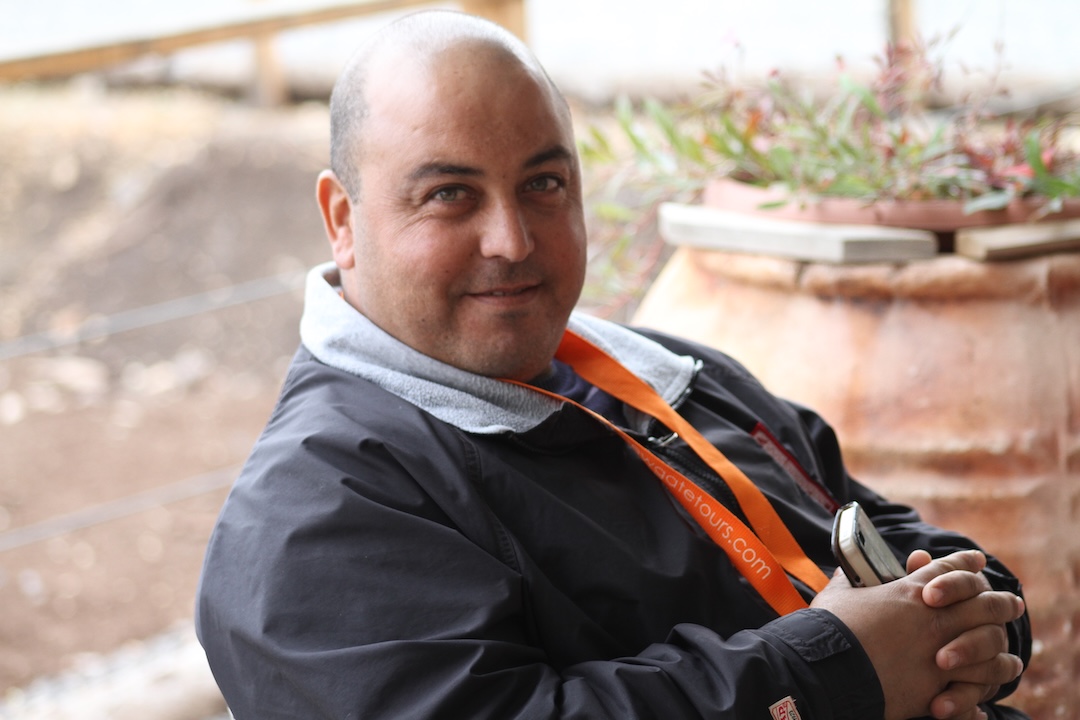
Waseem Bshara
Security Manager
“Don’t be too hard or they will break you. Don’t be too soft or they will bend you.”
When Waseem was a little boy, he remembers how his father trained him early for life. Was this a premonition of harder days to come? Dad was a butcher in the morning, a barber in the afternoon, and a musician and singer at family and community celebrations in the evening. His father would bring home a side of neck meat after work and prepare little portions. Then he sent the 6-year-old Waseem out to the neighborhood to distribute and sell them at a bargain price to the families delighting their good taste. The beneficiaries would reward Waseem with a few shekels.
Little did Waseem know that he and his three brothers—one a year older, another three years younger, and one just six months old—would tragically lose their 32-year-old father two weeks after his seventh birthday. It was a large family gathering on Independence Day, April 28, 1982, in Beit el-Bik, at the Jordan River’s entry into the Sea of Galilee. During the outing, their father became entangled in his fishing net after it was caught in a powerful river vortex. In a desperate attempt to save him, his 20-year-old brother was also pulled in and drowned. The following day, the second body was recovered by an army rescue team.
The remaining childhood years abounded in major difficulties for this half-orphaned family in a tiny home with very little government support. Their remarkable mother is their beloved Star today whom they honor with tender love. Rarely have I heard someone speak so highly of their mom. At twenty-six she was so strong and did an amazing job, primarily through her total dedication to her sons. Now they treasure her so much for her self-giving and her suffering on their behalf.
When the going gets tough the tough get going. The boys found little jobs every day and anywhere. An elderly lady was very generous to Waseem when he had collected about 300 eggs from the mischievous free-run hens who laid them in every conceivable hidden niche, in the nettles and weeds, and under bushes. She gave him 30 eggs to take home but his mom would not believe he had not stolen them. She took poor little Waseem by the ear with the 30 eggs to the lady only to discover that Waseem was totally innocent.
Catching pigeons, fruit harvesting, painting houses, construction work, welding, etc were steps on the career ladder. The boys learned self-reliance early. “Life put you in a jungle and you need to handle everything by yourself. Even 40+ years later we miss this paternal role in our lives.” They had matured early. Older young men invited them hunting and respected them beyond their years. They had quickly learned to survive.
Waseem went from State Park management to Hotel Receptionist at The Scots Hotel. Twenty years ago Waseem joined Magdala. He is now head of security but covers a lot of other Magdala needs and opportunities. He is our first and longest-standing employee, here from the beginning. Tourism fluctuates like a sinus curve, so he is still challenged to raise his 4 children. Amir, the oldest, will finish nursing this summer. Nivin is in her 4th year of medicine in Perugia, Italy. Juanito and Roisin are in high school.
Waseem smiled as he related how he knew Mahira. Since she is his very close friend’s sister, he was privileged to notice her behavior for a long time. One day he told his mother he wanted to marry Mahira. That history was sealed on August 15, 1998.
This Arab-Israeli Catholic builds bridges in his very person. He thinks you need to be friends with everyone. Goodness towards all without compromising your principles. “Don’t be too hard or they will break you. Don’t be too soft or they will bend you.”
Waseem says he has grown a lot in Magdala, with every excavation, every phase of construction, every event, the happy and sad ones. He finds it hard to put his finger on it. “You feel alive here. I love the feeling. For me it is a special place.”
Discover more articles from this category