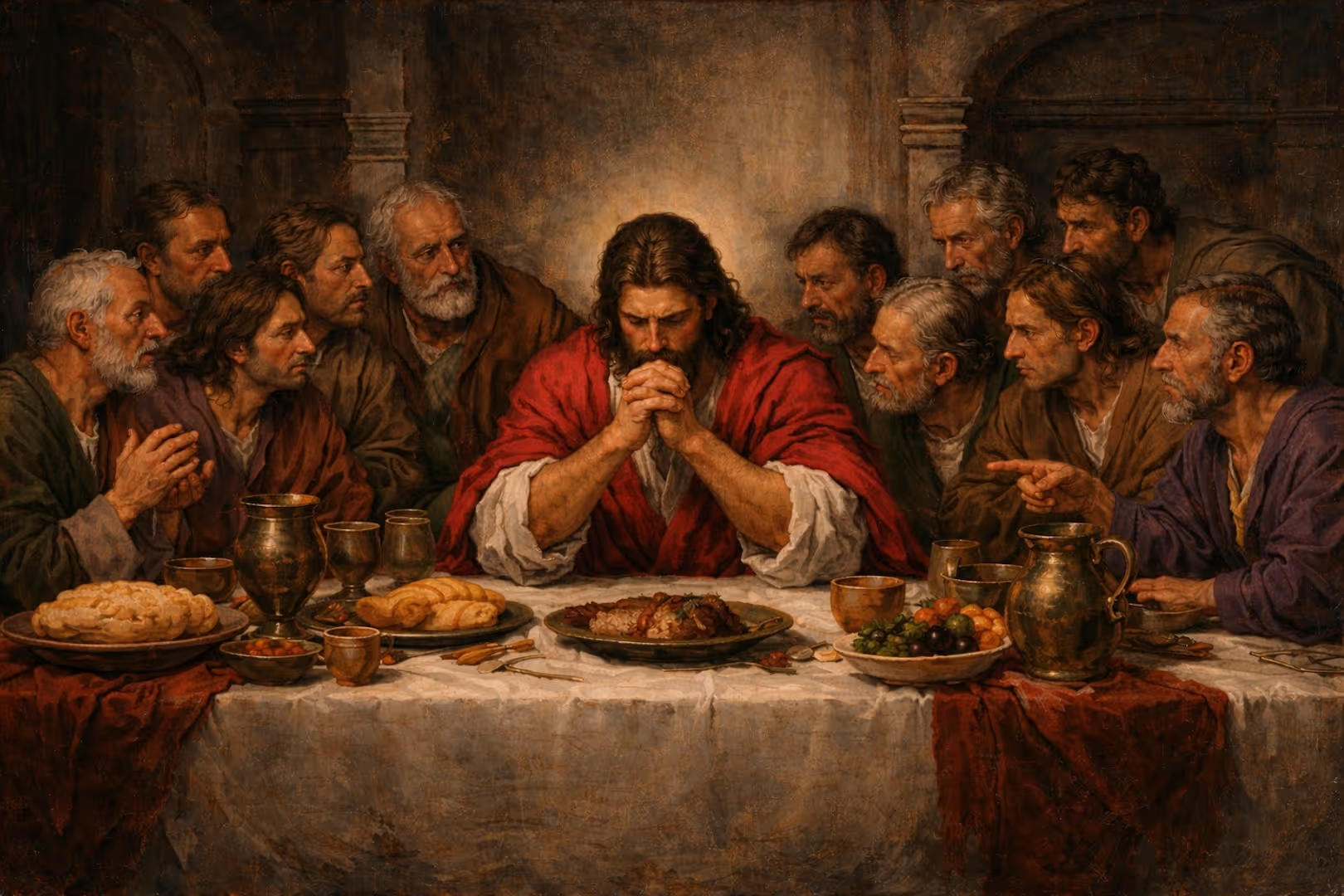
Are you tired of conflict? In times of bitter strife, we are threatened by grave loss. We search for what holds us all together. Here at Magdala our thoughts turn again to John 17:20-23 which drives our efforts to overcome the divisions and ease tensions we sense between us as disciples of Jesus.
“I pray not only for them, but also for those who will believe in me through their word,
so that they may all be one, as you, Father, are in me and I in you,
that they also may be in us,
that the world may believe that you sent me.
And I have given them the glory you gave me,
so that they may be as one, as we are one, I in them and you in me,
that they may be brought to perfection as one,
that the world may know that you sent me, and that you loved them even as you loved me.”
(John 17:20-23).
This astounding text surprises even more when we consider its context in chapter 17, the last of the five chapters of the Last Supper narrative of John's gospel, and the conclusion of the fifth discourse in this gospel, and within the context of the entire biblical vision of humanity. Let’s take a closer look! It could be very helpful to have your Bible beside you or open on another tab to cross-reference these fascinating relationships.
Biblical Background
Chapter 13 opens John's extensive account of the Last Supper expressing Jesus’ extreme love, washing the feet of his disciples, followed by his new commandment of love which stands in stark contrast to Judas’ betrayal and Peter's proximate triple denial. Chapter 17 closes the Last Supper account with three final verses about this same love, following Jesus’ final prayer quoted above. Then the Passion narrative begins in John 18. This love sounds like a repeating melody in John’s symphony that suggests the tone of the whole text.
The topics of chapters 14, 15 and 16 in between 13 and 17 treat of our relationship with and abiding in the Holy Trinity who dwells in us. We have access through Jesus to the inner life he shares as Son with the Father and the Holy Spirit, and experience their love, joy and peace despite the hostility of the “world” which is fundamentally overcome. In this Trinitarian communion, our sorrows here will turn to joy. Jesus’ oneness prayer, which astonishingly lets us participate in his dialogue with the Father, is basically the final brush stroke of the last of the five discourses in John’s gospel and as such, is quite significant.
Chapter 17’s structure allows it to be easily understood as corresponding to the Yom Kippur prayer: the High Priest enters the Holy of Holies and prays for forgiveness from God first for himself, then for the priests and finally for the whole community of God’s people. Jesus, the Lamb of God about to offer himself (Is 53), first prays for himself. Then he prays to his Father for his immediate disciples and finally for all future believers. His central petition in both cases is for our oneness as also it was for his immediate disciples in v 11. This oneness is not any random kind of social unity, but that of the Trinity, “like you and I are one.” What a breathtaking expression of our divinely anticipated and assisted oneness! This prayer for oneness, which originates in the divine depths and heights of Trinitarian love and fills Jesus’ heart during his passion rings powerfully through the millennia until the end of time.
John’s gospel resonates with the earliest beginning when its first words echo Creation: “In the beginning,” Genesis 1. The life of the Trinity precedes Creation, a revelation of God’s glory. The Last Supper treats in greater depth this Trinitarian relationship. Jesus is leading his disciples to this same glory (John 17:22), despite their fragility which becomes more than evident during his passion and death. Are we hearing another strain in his symphony when we take John 1, the Prologue, together with John 17, the High Priestly Prayer?
We could also keep in mind that the Word, through whom everything was made, became flesh and dwelt among us, John 1. Now in John 17 we are listening to this Word made flesh through his many words communicating the meaning of his self-offering love for us and our salvation. Like students parsing a poetry or prose text in school, we disciples benefit profoundly as we ponder the meaning, connectedness and depth of his prayer.
The oneness of the Last Supper Prayer also stands in contrast to the division of Babel in Genesis 11. Babel is the concluding story of the first part of Genesis, the primeval history showing humanity in deepening confusion and chaos. Chapter 12 begins the patriarchal accounts, the other part of Genesis, and narrates the call of Abram which initiates God’s plan of salvation.
Division, like that of Babel, was the result of pride, unity is the result of humility. After washing their feet and before undertaking the humiliation of his passion and crucifixion, Jesus’ final prayer is for their oneness. Already on Easter Sunday evening, John will contemplate the risen Jesus speaking Shalom, Peace, John 19:19-23, while breathing on the apostles the Holy Spirit with the reconciliation ministry of forgiving sin, the ultimate divider. While Luke’s Pentecost account, Acts 2:5-12, shows all those listening are able to understand the apostle’s preaching despite the multiplicity of languages, John sees Jesus pouring out the Holy Spirit to undo the roots of our division. The Holy Spirit continues to lead us to the fullness of truth in a process of oneness until the wedding feast of the Lamb. Worldly living sows division, while our oneness flourishes when we are docile to the Holy Spirit.
The Oneness of the Redeemed Human Family
This brief sketch of Jesus’ oneness prayer at the Last Supper in the context of the whole Bible brings us to appreciate that it is not a stand-alone prayer but, in a way, expresses the purpose of the history of salvation, to redeem the entire human family. The beauty of Jesus’ oneness prayer stirs us even more deeply, as a detail of a tapestry becomes even more striking when viewed within the whole. In the splendid tapestry of the Bible, God has woven these verses not randomly but to feast our mind, heart and soul. In these days of pain and division we need this encouragement. There are enough threads throughout the Scriptures to write a book on our oneness in Christ. We could also add how believers during the last two millennia have responded. But this short article helps us realize that the oneness of Jesus’ disciples and even of all of humanity is not a lost cause.
Following Cain’s slaughter of his brother in the account of the very first human family and the confusion of the human race, fallen into chaotic, abusive relationships, cries for redemption ring out through history until today. The biblical narrative constantly belabors the intimate connection between love of God and love of neighbor, so that we cannot conceive of our salvation as a private, individual matter received in isolation.
How much could we develop a Christ-like sense of the importance of the oneness of the redeemed? We ourselves will be the first beneficiaries. Of course our proclamation to a whole world still longing to discover the One whom the Father has sent will be more cogent. Our oneness is key to their discovery. Come Christians, let us realize, celebrate and radiate the centrality of our oneness and its core substance!
His Prayer Before the Cross: “That All May Be One”
The culminating prayer of the Last Supper’s five chapters is the culminating goal of the entire work of salvation. The Creator’s original purpose is gifting humanity with communion with the Divinity, creating us in his image and likeness. Jesus expresses this supreme desire of his heart before he enters his passion, death and resurrection, by which to give us a Pentecost taste of the unity of all peoples. Parents’ earnest desires for harmony among their children are but faint shadows of God’s passion for the oneness of all of us, his children. Unity is core and central to Christ’s mission. Right before he offers this prayer for our oneness, Jesus tells his Father in v 19 that he is sacrificing himself so we can be sanctified, which means to be taken into the unity of the Father and the Son, sharing their glory as the following verses make explicit. The redemption of humanity is before our very eyes, which is the explicit purpose of the Incarnation, of Christ himself who came down for us and for our salvation. His redemption gift to us of oneness is our recognition code.
When Jesus offers his prayer, his suffering and cruel death are still ahead of him as are the sufferings of his disciples for the entire time of the Church on Earth until the Wedding Feast of the Lamb whose one bride hastens to that everlasting nuptial joy. The power of his words of prayer accompanies, inspires and strengthens us still. God’s word is alive and lifegiving!
It’s no wonder that so many Christians in our time long for this unity. Here at Magdala One Step Closer – Hospitality Together strives to express the oneness we already are blessed to enjoy and called to witness in our joint care for the needy around us. Prejudices give way to friendships, and the Holy Spirit will gradually lead us to greater oneness so the world can recognize its source. This oneness is primarily that of each person in Christ. But Jesus’ prayer requires that our oneness also be ever more visible and evident. It’s precisely because of the visibility of our oneness that the world may believe and know that the foundational love of the Trinity for all of humanity already inhabits our beautiful cosmos.
The Gift and Challenge of Our Real Visible Oneness
Jesus’ prayer implies that the challenge for humankind to live in unity across all cultures and all millennia is so difficult and insurmountable without divine assistance. Therefore, the visible existence of this unity manifests precisely that undeniable divine assistance, and that salvation already has established an indestructible beachhead! It may suffer attack from inside and outside but his oneness prayer to the Father is a guarantee similarly powerful to Mt 16:18.
May we all be one! If Jesus is in each of his disciples as the Father is in him, Jn 17:21, how could any disciple oppose or hate or injure another of Jesus’ disciples! We are one. We have many issues to wrestle with. Let’s join forces and wrestle together to resolve them and no longer fight against each other!
As we head toward our celebration of Easter, a widespread call accompanies us this Lent to disarm our language, avoid harsh words, rash judgment and speaking ill of those who are not present and cannot defend themselves, refraining from words that offend and hurt our neighbor. Instead let’s reconcile and express our oneness to prepare to meet the Risen Lord whose first word to us is Shalom, his balm for conflicted hearts longing for oneness!

Anat Arav, Purchasing Manager, Magdala.
“Magdala is a positive learning adventure.”
When Anat Arav was just thirteen years old, her parents moved with her and her little sister from Dnipro, Ukraine to Israel. She experienced a great relief from the negativity of the school atmosphere in her native country. The Jewish community in Ukraine was big enough and her family lived all the Jewish traditions. She is grateful that antisemitism has declined and the environment has improved in the decades since then.
Her mother was a music teacher in the primary school and played the piano while her Dad was an electrical engineer who switched to storage and warehouse management on immigrating to Israel.
Anat studied logistics and purchasing at Tel Aviv University and has spent her whole career in the purchasing industry, especially internationally with India, China and Europe. She married Pavel, also a Ukrainian electrical engineer like her father, who has dedicated his skills to factory maintenance. They are blessed with two young adult daughters. The twenty-one year old will start university this fall and just finished her military service. Her younger sister is eighteen and just began her training in the army.
Anat says she likes a challenge and can’t spend too much time doing the same thing. “Routine kills me.” So she switched to purchasing for Hotel Hacienda and enjoyed this experience. Six months ago she applied for a position in Magdala.
Magdala’s cultural mix appeals to Anat, and she appreciates the rich communication that ensues from it. Previously Anat had little opportunity to get to know Christians. “Magdala is like a family and I love working here. The great respect for women opens the door for all of us to readily contribute our best with our own personalities. It's a positive learning adventure.”
Discover more articles from this category