Mary Magdalene and Magdala
Her Hometown, Her Witness, and the Gospel Today
Mary Magdalene is one of the clearest witnesses in the Gospel: a woman healed by Jesus, a generous disciple who helped sustain his ministry, faithful at the Cross, present at the tomb, and sent by the risen Lord to announce the Resurrection. In John 20, Jesus gives her a mission: “Go to my brothers and tell them…” (John 20:17). Mary Magdalene then goes to the disciples and announces, “I have seen the Lord” (John 20:18).
If you feel drawn to her story, Magdala invites you to go further: visit the site, pray with the Gospel, watch Magdala’s media programs, entrust a loved one through a Mass intention, inquire about volunteering, or support the work that keeps this place open for pilgrims and visitors from around the world.
Magdala, on the western shore of the Sea of Galilee, is traditionally remembered as her hometown. Today, Magdala helps pilgrims, Christians, seekers, and scholars encounter the world in which Mary Magdalene lived: the Jewish traditions of Jesus’ time, the geography of Galilee, the archaeology of a first-century town, and the Gospel message that continues to speak to the human heart.
Mary Magdalene was a disciple of Jesus, traditionally understood as Mary of Magdala. The Gospels present her as a woman liberated and healed by Christ, one who accompanied him, helped provide for his ministry, remained near him in his Passion, came to the tomb, encountered him risen, and was sent to proclaim the Resurrection. Magdala is important because it links her witness to a real first-century town in the Holy Land, one that reveals the Jewish traditions, cultural life, and geography of Galilee in the time of Jesus.
Mary Magdalene’s importance was first given to her by Jesus himself. The Church later recognized and celebrated what the Gospel already reveals: a woman personally encountered by Christ, healed by him, faithful to him, and sent by him. In 2016, Pope Francis elevated her July 22 liturgical celebration from a memorial to a feast, inviting Christians to reflect more deeply on the dignity of women, the new evangelization, and the mystery of divine mercy.
The short answer
Her story is not finally about speculation, legend, or myth. It is about encounter, healing, gratitude, service, fidelity, and mission. Magdala matters because it lets that story be contemplated in a real place: in the land, in the stones, in the memory of believers, and in the work of encounter that continues today.


Who was Mary Magdalene?
Jennifer Ristine, author of Mary Magdalene: Insights from Ancient Magdala, expresses this balance well. She writes that “Mary Magdalene’s person and life represent a mystery,” while also noting that “the essential message of her life-project shines out for all to admire.”
Mary Magdalene was a woman personally touched by the saving power of Jesus. Luke names her among the women who accompanied Jesus and the Twelve and helped provide for them “out of their resources” (Luke 8:1-3). This means her discipleship was not passive. She followed, served, supported, and helped sustain the community around Jesus.
A careful Christian reading distinguishes between what Scripture clearly says, what later tradition proposed, and what remains open to interpretation. This protects both theological truth and Mary Magdalene’s dignity. It also lets her story speak more broadly: all of us need redemption, healing, and freedom. Mary Magdalene is not reduced to a label. She is remembered because she encountered the living Christ and became his witness.
The New Testament does not say that Mary Magdalene was a prostitute. It does affirm that Jesus delivered her from seven demons. That detail should not be minimized, as if her liberation were merely symbolic or polite. The Gospels present her as someone who truly needed the healing and saving power of Christ. At the same time, the tradition that identified her as a prostitute arose later in the West and should not be presented as a direct biblical statement.
Mary Magdalene in Scripture
This is not a minor episode. The risen Jesus entrusts her with the first proclamation of Easter. Her personal encounter becomes public testimony. She is not merely near the story of the Resurrection. She is sent by Jesus to announce it.
The Gospel of Luke introduces Mary Magdalene among the women who traveled with Jesus and the Twelve and “provided for them out of their resources” (Luke 8:1-3). The Gospels of Matthew, Mark, Luke, and John place her near the final events of Jesus’ Passion and Resurrection. She remained close when many had fled. She saw where Jesus was laid. She came again to the tomb.
Then comes the moment that has shaped Christian memory ever since. In John 20, Mary stands outside the tomb weeping. Jesus says to her, “Mary!” She replies, “Rabboni!” Jesus then sends her: “Go to my brothers and tell them…” (John 20:16-17). Mary Magdalene goes and announces to the disciples, “I have seen the Lord” (John 20:18).
Why does the Church honor Mary Magdalene?
The Church honors Mary Magdalene because Jesus first honored her with a mission. He called her by name, revealed himself to her after the Resurrection, and sent her to announce the Good News to the apostles. Her importance begins in the Gospel itself.
This memory matters today. Mary Magdalene’s witness was not only words. It was practical love: accompanying Jesus, serving the community, supporting the work from her resources, standing near the Cross, going to the tomb, and then announcing what she had seen. Her example speaks to every person who serves, volunteers, sustains a community, or continues to love faithfully even while carrying personal wounds or burdens.
Eastern Christian tradition often remembers Mary Magdalene among the Myrrh-bearing women. This title highlights a beautiful and practical dimension of their love. They went to the tomb not to make a statement, but to complete the burial rites proper to their people’s tradition. They hastened there with spices, wondering who would roll away the stone. Their love was concrete, courageous, and faithful.
Christians across many traditions recognize her in this way. The Catholic Church celebrates her feast on July 22. Eastern Churches also celebrate her on July 22 according to the Gregorian calendar, or August 4 according to the Julian calendar, and honor her with the title “Equal-to-the-Apostles.” Many Anglican, Episcopal, Lutheran, and other Reformation communities also commemorate her on July 22 as the first witness to the Resurrection and a model disciple.
Mary Magdalene and the Myrrh-bearing women
In the Catholic Church, Pope Francis elevated the July 22 celebration of Saint Mary Magdalene from a memorial to a feast in 2016. Archbishop Arthur Roche explained that this decision invites the Church to reflect more deeply on “the dignity of women, the new evangelization and the greatness of the mystery of divine mercy.”
This language does not blur the distinctions within the Church. It highlights the magnitude of her witness. Mary Magdalene becomes a model of personal encounter, steadfast love, humble service, and true evangelization.
The Preface for her feast says that Christ appeared first to Mary Magdalene after the Resurrection, that she had witnessed him dying on the Cross, sought him in the tomb, and was first to adore him newly risen from the dead. It then says that Christ “honored her with the office of being an apostle to the Apostles.”
Was Mary Magdalene from Magdala?
A responsible presentation should still be careful. Not every detail of first-century naming conventions, place identification, or later tradition can be stated with mathematical certainty. The traditional association is well rooted, the spiritual significance is clear, and scholarship should be treated with humility.
The Gospels speak of her as Mary Magdalene, commonly understood as Mary of Magdala. Christian tradition has strongly associated her with Magdala on the Sea of Galilee, and the memory of the place has been preserved through the centuries.
In Mary Magdalene: Insights from Ancient Magdala, Jennifer Ristine notes that Magdala maintained its tradition as the hometown of Mary Magdalene across time. Medieval pilgrims and travelers documented a church identified with the site of Mary Magdalene’s house. The modern Hebrew name Migdal and the historic memory of El-Mejdel also preserve continuity with the name of the place.
Why Magdala matters in the Holy Land
This is why Magdala speaks so powerfully to Christian pilgrims. It is not only associated with Mary Magdalene. It is a place of encounter, known as a crossroads of Jewish and Christian history, where her story, the ministry of Jesus, Jewish memory, and Christian faith converge.
Magdala matters because it makes the Gospel tangible.
Magdala also carries a specifically Christian importance because of its first-century synagogue. Coins found there support the conclusion that the synagogue was in use during the public life of Jesus. Pilgrims standing in Magdala are therefore not contemplating an abstract Gospel world. They are standing in a place where Jesus may have taught and where the first-century world of Galilee can still be imagined with unusual clarity.
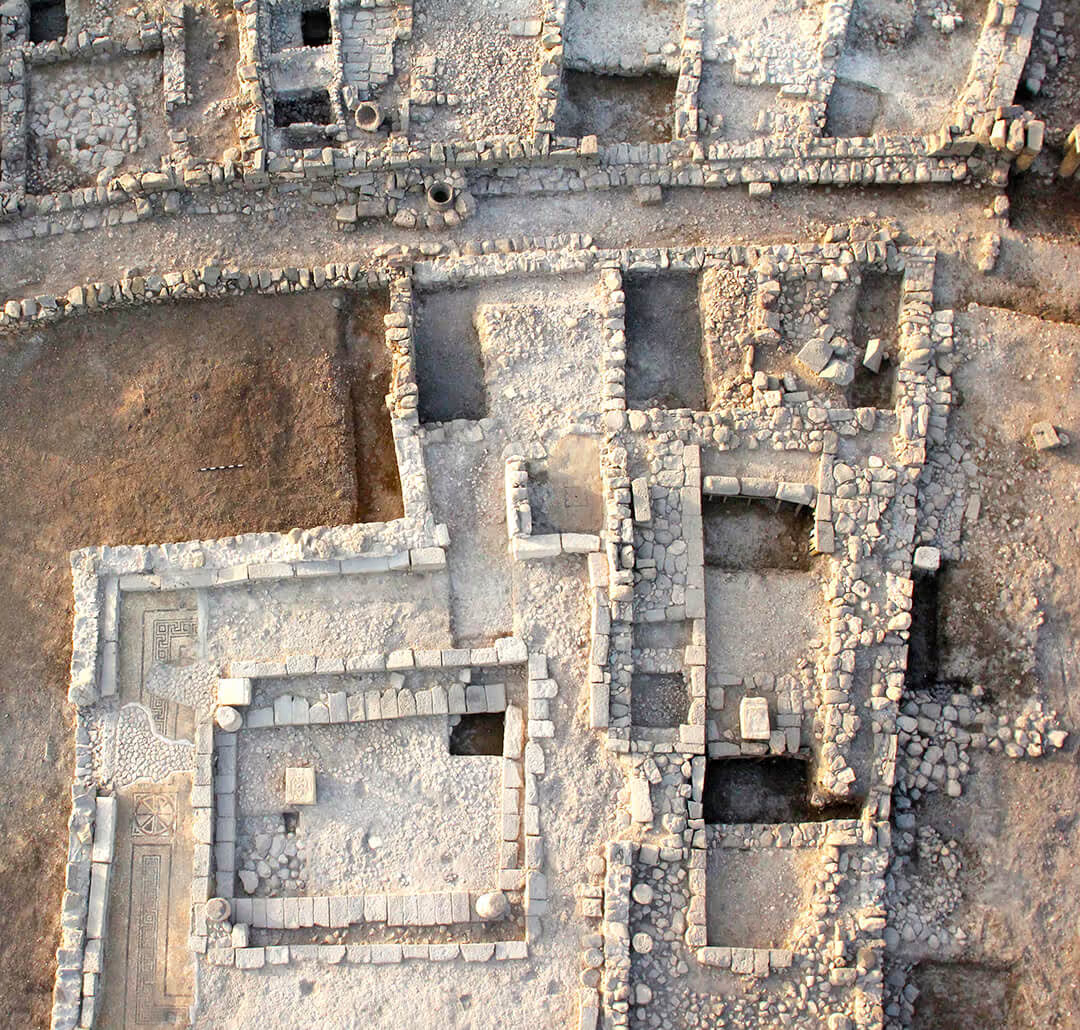
Ancient Magdala was not an insignificant place. Archaeological and historical evidence present it as a thriving first-century town on the Sea of Galilee, marked by fishing, commerce, Jewish observance, and contact with surrounding cultures. Ristine describes ancient Magdala as an economically thriving city in the time of Jesus and notes that many scholars consider it one of the larger and wealthier towns on the western shore of the Sea of Galilee.
The town’s marketplace, harbor, ritual baths, roads, and domestic areas help reconstruct the setting in which daily life unfolded. Magdala was shaped by Jewish heritage, economic vitality, and the wider cultural currents of Galilee.
Archaeology, memory, and encounter
That line expresses the deepest truth of the site. Magdala is not important merely because it preserves ruins. It matters because it points beyond ruins to redemption.
Magdala’s importance is not only historical. It is also spiritual.
Ristine captures this beautifully when she writes that the “resurrecting” of the ancient town brings Mary Magdalene’s voice to the forefront again, not as an isolated heroine, but as “a woman who points the way to the One who has the answer to our perennial human condition.”
The harbor remains, the shore road, the market area, the ritual baths, and the synagogue do more than inform the mind. They sharpen the Christian imagination. They help pilgrims pray where the land speaks of the Gospel events.
The same is true of the contemporary spaces built at Magdala. Ristine notes that Duc In Altum was built to commemorate the public life of Jesus and to honor the dignity of women. Its boat altar, poised above the ancient harbor, is not only architecturally memorable; it expresses Magdala’s spiritual vocation: to help visitors move from information to encounter.
Why Mary Magdalene still matters today
That is why Mary Magdalene remains relevant for evangelization today. The Church does not honor her because she was famous. The Church honors her because she encountered, served, remained, recognized, and proclaimed. She is a witness of mercy and a model of authentic Christian proclamation.
Mary Magdalene still matters because the modern world still needs her witness.
Ristine makes this point with memorable simplicity: “She would prefer that all conversation about her point the way to Jesus.”
- She matters to those who seek healing.
- She matters to those who have known grief, confusion, sin, trauma, or spiritual dryness.
- She matters to women longing to see the dignity of female discipleship clearly honored within the Gospel and the Church.
- She matters to Christians, pilgrims, seekers, and scholars because she is both historically rooted and spiritually alive in Christian memory.
- She matters to volunteers and servants because her gratitude became practical support, service, fidelity, and mission.
- She matters to every disciple because she shows what love looks like when it remains near Christ in suffering and then goes forth in hope.
Mary Magdalene also resists distortion. She is not a canvas for modern fantasies. She is not a symbol emptied of doctrine. She is not valuable because she can be sensationalized. She is valuable because her life points to Jesus.
Encounter Magdala today
Come to Magdala to pray where the Gospel still breathes. Come to Magdala to entrust your intentions. Come to Magdala to watch, learn, and go deeper. Come to Magdala to support a work that keeps the Holy Land present for the Church and the world. Come to Magdala to walk where Jesus taught.
To tell the story of Mary Magdalene well is to invite people into more than knowledge.
In Mary Magdalene: Insights from Ancient Magdala, Jennifer Ristine presents Magdala as a place where ancient stones, Scripture, and present-day life meet. Mary Magdalene’s witness continues to animate those called to spread the Good News in her hometown and beyond it.
- Magdala is Mary Magdalene’s hometown, traditionally remembered and newly encountered.
- Magdala is a place to pray.
- Magdala is a place to remember.
- Magdala is a place to walk through the world of the Gospel.
- Magdala is a place to honor the dignity of women in salvation history.
- Magdala is a place to preserve and communicate the heritage of the Holy Land with responsibility, accuracy, hospitality, and respect.
- Magdala is a place to be inspired to serve, volunteer, and sustain communities of faith and encounter.
- Magdala is a place to bring your intentions, your gratitude, your grief, your family, your pilgrimage, and your hope.
You can support Magdala by donating, requesting a Mass intention, watching Magdala media, inquiring about our volunteer program, or planning a pilgrimage.
Frequently asked questions
Mary Magdalene was a disciple of Jesus who was healed by him, accompanied him, helped support his ministry, remained near his Passion, came to the tomb on Easter morning, encountered the risen Christ, and announced the Resurrection to the apostles.
Christian tradition strongly identifies her as Mary of Magdala, linking her to the town on the Sea of Galilee that preserved her memory through the centuries.
The Gospels do not explicitly say that Mary Magdalene was a prostitute. They do say that Jesus liberated her from seven demons. That indicates a serious need for healing and redemption, but the later association with prostitution should not be presented as a direct biblical statement. Her story is ultimately about the transforming mercy of Christ.
No canonical Gospel says that Mary Magdalene was married to Jesus. The idea is not part of the Church’s faith and is not supported by the biblical witness. The Gospels present her as a disciple, witness, and messenger of the Resurrection.
No. The Gospels do not present Mary Magdalene as Jesus’ girlfriend. They present her as a healed and faithful disciple who followed him, supported his ministry, remained near the Cross, and announced the Resurrection.
She is called the Apostle to the Apostles because the risen Jesus sent her to announce the Resurrection to the apostles. In the Catholic liturgy for her feast, Christ is said to have “honored her with the office of being an apostle to the Apostles.” Eastern Churches also honor her as “Equal-to-the-Apostles.”
Her feast day is celebrated on July 22. In 2016, Pope Francis elevated that July 22 celebration from a memorial to a feast, underscoring her importance as a witness of the Resurrection, a model disciple, and a sign of divine mercy and evangelization.
Magdala is important because it is traditionally associated with Mary Magdalene and because it preserves a first-century Galilean setting that includes a synagogue from the time of Jesus, harbor remains, ritual baths, market areas, and evidence of a thriving commercial town.
The site and the Gospel geography make Magdala highly significant within the world of Jesus’ Galilean ministry. Scholars connected to the excavations say it is highly likely that Jesus taught in its synagogue, though this should be expressed as a strong historical likelihood rather than an absolute proof.
Pilgrims can experience archaeology, prayer spaces, Duc In Altum, the Sea of Galilee setting, Gospel reflection, and a vibrant ministry centered on encounter, pilgrimage, service, and evangelization.
Mary Magdalene matters to Christians, pilgrims, seekers, and scholars because she shows the movement from encounter to healing, from gratitude to service, from fidelity to proclamation. She is a witness of mercy, courage, and hope.
Yes. Magdala at the Sea of Galilee in the Holy Land, where Mary Magdalene is traditionally remembered to have lived, offers historical context, geographical surroundings, religious atmosphere, cultural setting, and biblical reflection in one place. Visitors can come for a tour, take the 360 tour, or continue learning through Magdala’s website and media.
You can visit as a pilgrim, request a Mass intention, watch Magdala’s media and virtual pilgrimage content, support the project through donations, inquire about volunteer opportunities, or share Magdala’s resources with others.